FutureForests
Understanding today's forests to solve tomorrow's climate challenges
About FutureForests
FutureForests is a research and training network focused on understanding how European forests respond to environmental threats such as climate change, rising pollution, and extreme weather. Funded by the European Union through their Marie Skłodowska-Curie Actions (MSCA) initiative, the project connects nine ‘flagship’ forest research facilities across Europe with the intention of training 15 next generation Doctoral Researchers in advanced forest ecology, soil science, and ecological modelling. By bringing together 23 academic and industry partners, the network aims to provide evidence-driven insights for major environmental policies, such as the EU Green Deal, while equipping a new generation of scientists with the skills needed to protect future forest ecosystems from climate change.
Find out more about our 9 flagship facilities
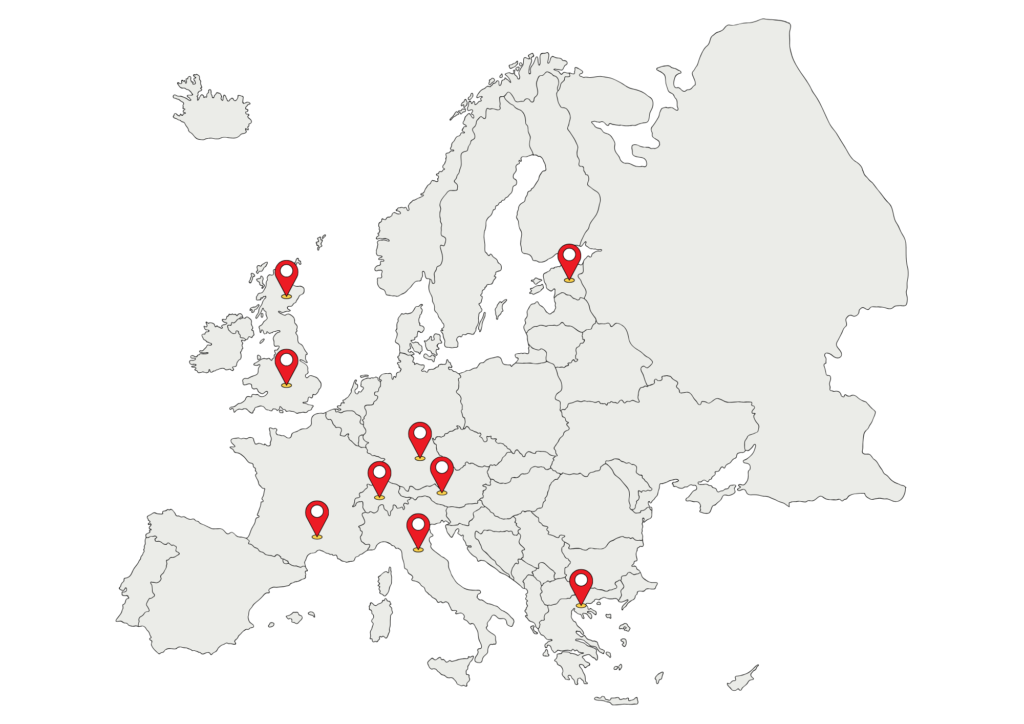
BIFoR-FACE (Free Air CO2 Enrichment): Located in central England and hosted by the University of Birmingham, this facility investigates mature oak forest responses to elevated atmospheric CO2.
FAHM (Free Air Humidity Manipulation): Hosted by the University of Tartu in Estonia, this experiment assesses the effects of elevated air humidity and soil moisture on boreal tree species.
KROOF (Kranzberg Forest Roof Experiment): Located in southern Germany and hosted by the Technical University of Munich, it focuses on the impacts of recurrent summer droughts on mixed beech and spruce forests.
VPDrought Platform: Situated in the Pfynwald forest in Switzerland and hosted by WSL, this facility manipulates vapour pressure deficit (VPD) and soil moisture to study atmospheric and soil drought impacts.
O3HP (Oak Observatory at the OHP): Hosted by Aix-Marseille University in France, this site uses rain exclusion and soil heating to study the interactive effects of drought and warming on Mediterranean oak forests.
Sani Environmental Observatory (SEO): Located in Chalkidiki, Greece, and hosted by ELGO-FRI, this facility investigates the effects of understory fire fuel removal on carbon sequestration and fire risk in Mediterranean pine forests.
Cansiglio Experimental Site: Hosted by the University of Bologna in Italy, this site simulates both above and below canopy wet nitrogen deposition in a mature beech forest.
Glencorse Woodland Experiment: Hosted by the UK Centre for Ecology & Hydrology, this facility utilizes wind-controlled ammonia fumigation to study the impacts of dry nitrogen deposition on forest biodiversity.
Austrian Central Alps Mountain Forest: Hosted by the University of Innsbruck, this long-term experiment assesses the resistance and recovery of subalpine tree species (larch and spruce) to recurrent summer droughts.
GET IN TOUCH
If you'd like to get in touch regarding the project please contact the FuturForests Coordinator Professor Sami Ullah (Chair in Biogeochemistry, Birmingham Institute of Forest Research, University of Birmingham, UK) at s.ullah@bham.ac.uk.